More Than Funding
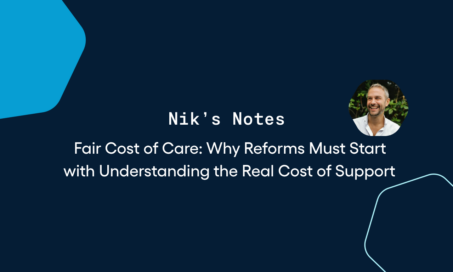
Nik Jones has worked in health and social care for over 25 years, with just under 20 years as a Registered Manager across a range of care homes. The experience he gained from working on the front line of the sector has been translated into data and insight to help understand how CareCubed can best serve providers and commissioners alike.
When we talk about the sustainability of social care, funding inevitably dominates the conversation. It matters enormously, but sustainability is also about how we value the people delivering care, how we describe their work and whether they can see a long-term future in the profession.
During the COVID-19 pandemic, I was working as a registered manager. Like many across the sector, I remember the increased public recognition of health and social care workers. It was a powerful acknowledgement of work that had always been taking place in care homes, supported living services, and communities.
But it also highlighted something I had felt for many years: social care is essential, yet not always as visible or as well understood as the other areas of health and care.
How we talk about social care influences whether or not a young person who is leaving education considers it a genuine career path, whether someone who is looking for a change of direction sees an opportunity, or if an experienced practitioner believes they can continue to develop in the sector without leaving the work that they value.
The Bigger Picture of Social Care in Practice
Public understanding of social care can often focus heavily on personal care. Supporting someone with personal care does require skill, sensitivity, and trust, but it is only one part of a much broader role.
Good social care is also about relationships, communication, judgement, and problem-solving. It requires understanding what matters to someone and finding ways to increase independence and autonomy.
This can mean developing independent living skills, taking part in community activities, or supporting someone through periods of change to obtain new experiences.
From my own years working on the front line of social care, some of my most valued memories are of supporting people to attend major sporting and cultural events. These were enjoyable days but were about more than just a day out. They enabled people to participate in their communities, pursue interests and be present in spaces where people drawing upon care services have not always been sufficiently visible.
Those experiences are part of the story of social care, and I do not think we communicate that story often enough. If you want more people to see social care as a profession with a future, that story needs to begin in schools, colleges, and careers services. Social care should not be presented as a fallback or temporary job. It should be understood as a skilled, purposeful long-term career that offers multiple routes for development.
Apprenticeships and vocational routes have a significant role, but entry into the sector is only one part of the whole picture. People need to see the journey this career path can take them on.
Progression Need Not Be Management
After almost 30 years working in social care, one thing I have come to appreciate is just how important workforce stability is. Yet we have traditionally had a narrow idea of what career progression looks like for the sector.
For many talented frontline practitioners, moving into management can appear to be the main or only route to greater responsibility, recognition, and earnings. For some people, that is the right path. Strong managers and leaders are critical.
However, being an excellent practitioner and being an excellent manager require different skills.
I have seen very capable practitioners move into management because it was the natural next step, rather than because it was where their strengths or ambitions lay. Individuals can find themselves in a role that does not make the best use of their abilities, while the people receiving care lose an experienced practitioner from their day-to-day lives.
Alongside leadership and management routes, we could create stronger pathways that allow practitioners to deepen their frontline expertise. A tiered structure, much like the structure used in the NHS, could recognise experience, specialist knowledge, advanced practice, and the ability to support people with increasingly complex needs. Progression would mean developing expertise without necessarily moving away from direct hands-on support.
This recognises that leadership is only one form of professional development, and not the definition of it.
Retaining Expertise Through Continuity
Experience in social care is not only measured in years. Over time, skilled practitioners build up a detailed knowledge of the individuals that they support. Through the recognition of subtle communication changes, knowledge of what contributes to anxiety, and what adjustments contribute to increases in confidence and independence.
For those who have complex needs, especially those who have experienced repeated changes in the professionals around them, continuity is significant. Fostering the opportunities for frontline practitioners to develop professionally and financially while staying in direct practice can support not only workforce retention but also better outcomes for cared-for individuals.
The Impact of Skilled Support
One moment from my own career that continues to capture, for me, the depth of what social care can achieve was the work I did with a young man who had cerebral palsy.
He used a power chair and a communication aid. When he arrived at his new home, I was informed that he could not assist himself at mealtimes and was not able to eat independently like his friends that he lived with, but rather than accepting that this would always be the case for him, we explored what equipment and adaptations were possible that could give him greater control and more autonomy.
We changed the tray on his wheelchair, found a bowl that could be secured and keep his food warm, and adapted an assisted arm that he could use to hold a spoon. Developing this skill for him took patience, experimentation, and months of practice; it was trial and error for us, as well as him. There were frustrating moments, but we worked through it together. Eventually, he was able to eat his meals independently.
I remember, at one Sunday dinner, we were all gathered around the table having our food and watching him eat unaided and independently alongside everyone else. To others, it may have appeared to be a small moment. Yet, for him, it delivered a life-changing step towards greater autonomy.
He no longer needed someone sitting beside him; he could take part in the meal on his own terms, listen to the conversation, and decide his own pace. It gave him greater independence, but it also supported something not measured with as much ease: confidence, participation, and self-worth.
Sustainability and Social Value
Discussions surrounding social care reform quite rightly consider funding, commissioning, integration, and capacity, yet we also need to think about the social and professional value attached to care work.
Pay is a central aspect of this, as it is difficult to build a sustainable workforce if remuneration does not reflect skill, responsibility, and complexity. We often talk about whether services are sufficiently funded to deliver care but should also be considering whether those who provide this care are appropriately rewarded for the work that they do. Alongside pay, there is opportunity to strengthen professional development, recognise specialist frontline practice and improve wider public understanding of what a career in social care involves.
Moving beyond conversations that position social care and the NHS as competing for recognition, there needs to be wider understanding of how they play distinct roles but remain interlocked. Pressure and instability in one will ripple over to the other and impact those who rely on these services.
The workforce challenges can move beyond filling vacancies by looking at the curation of a wider, more fulfilling career and professionalisation of front-line roles. If we can do this, then sustainability becomes a part of building consistent, skilled, and person-centred support for those who rely on care while also making the profession one that people are eager to and proud to be a part of.